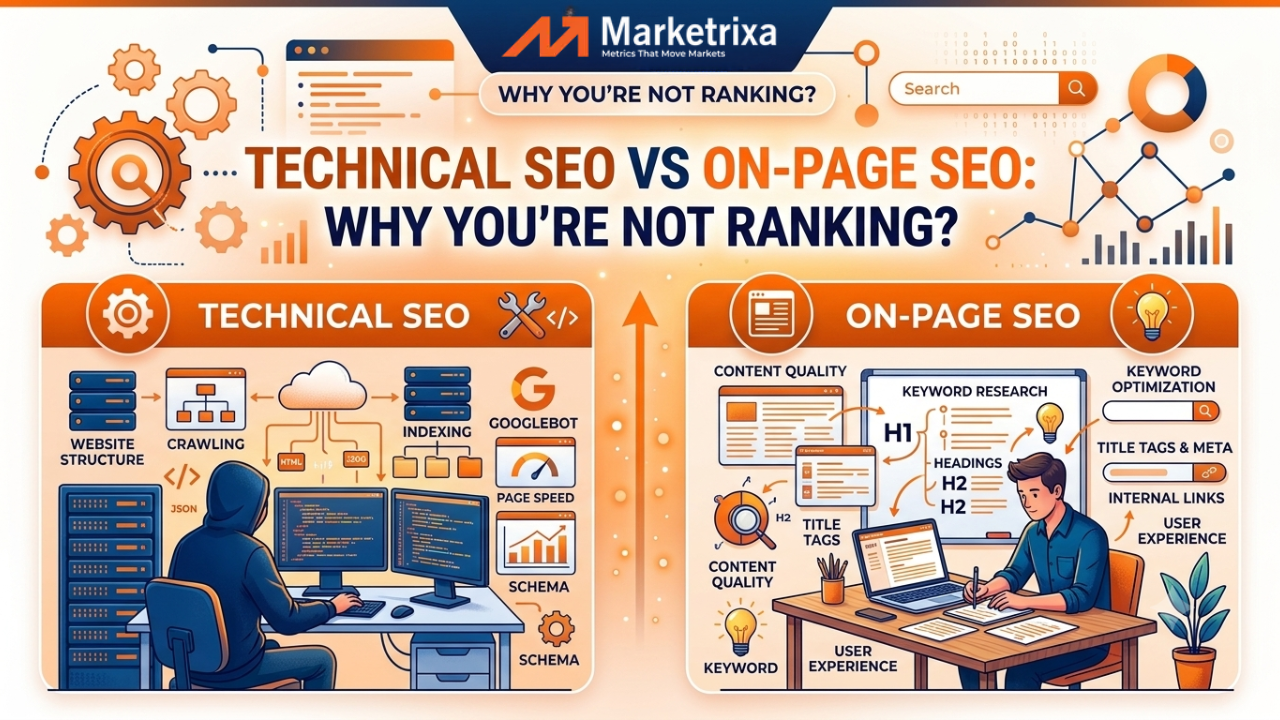
You've done everything "right." Your blog is packed with well-researched articles, your product pages read beautifully, and you've spent hours crafting content your audience actually wants to read. Yet your website is nowhere near page one of Google.
If this sounds familiar, you're not alone — and the problem probably isn't your content at all. It's far more likely to be a gap between two pillars of search engine optimization that too many businesses treat as the same: technical SEO vs on page SEO.
At Marketrixa, a digital marketing company based in Ahmedabad, we've audited hundreds of websites that had excellent content sitting on a broken foundation. In this blog, we'll break down what each type of SEO actually means, why both matter, and how understanding the difference can be the missing piece that finally gets your website ranking.
What Is Technical SEO?
Technical SEO refers to the behind-the-scenes optimizations that help search engines crawl, index, and understand your website efficiently. Think of it as the plumbing and wiring of your house — invisible to visitors, but essential for everything to function.
Technical SEO covers things like:
Website speed and Core Web Vitals
Mobile responsiveness
Site architecture and internal linking structure
XML sitemaps and robots.txt configuration
Crawlability and indexability
Structured data (schema markup)
HTTPS security and canonical tags
Fixing broken links and duplicate content issues
If Google's bots can't crawl your site properly, or if your pages take eight seconds to load, it doesn't matter how good your content is — search engines may never rank it, and users will bounce before they even read a word.
What Is On-Page SEO?
On-page SEO, on the other hand, deals with everything on the actual page that helps both users and search engines understand what that page is about. This is where content quality, keyword usage, and user experience come into play.
Key elements of on-page SEO include:
Title tags and meta descriptions
Header tag structure (H1, H2, H3)
Keyword placement and density
Internal linking within content
Image alt text
URL structure
Content readability and relevance
User engagement signals like time on page
This is exactly why businesses invest in dedicated on-page SEO services — because writing great content isn't the same as optimizing that content for search visibility. A well-written blog post that ignores on-page best practices will struggle to rank, no matter how insightful it is.
Technical SEO vs On-Page SEO: The Core Difference
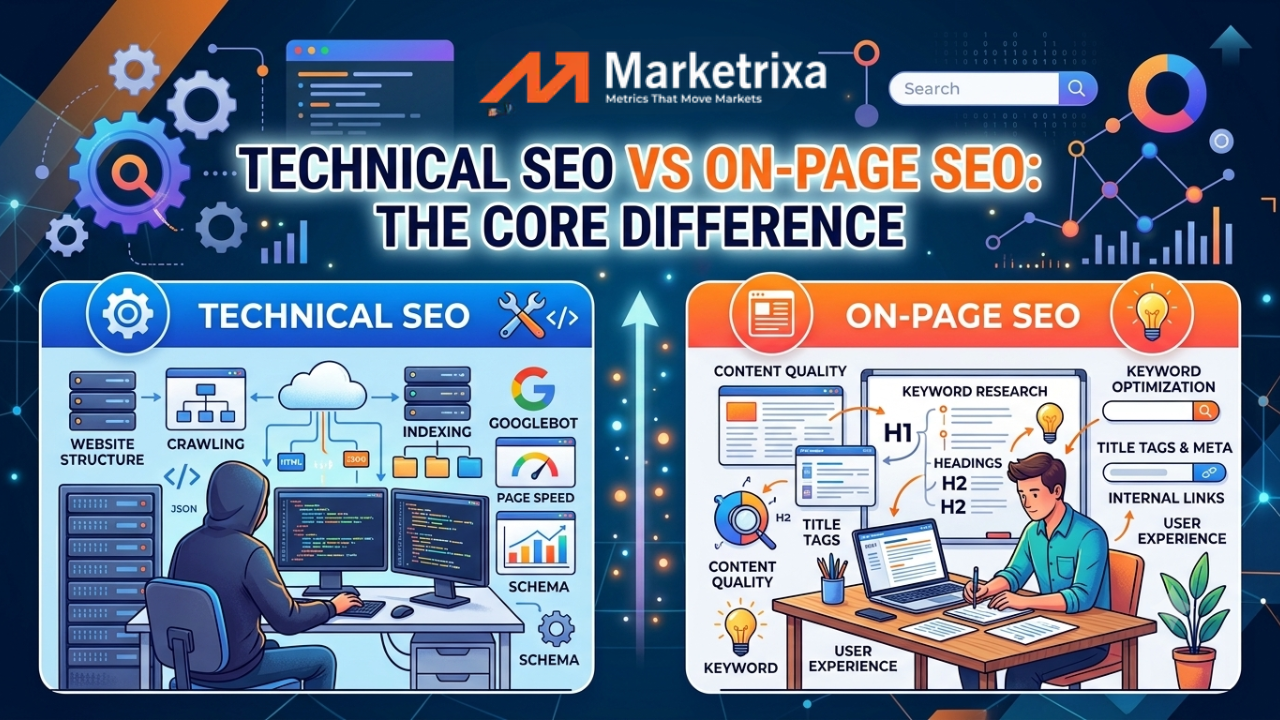
The simplest way to understand technical SEO vs on page SEO is this:
Technical SEO determines whether search engines can find, crawl, and index your website at all.
On-page SEO determines whether, once found, search engines understand and value your content enough to rank it well.
You need both working together. A technically flawless website with thin, poorly optimized content won't rank because there's nothing valuable for Google to reward. Conversely, phenomenal content on a slow, poorly structured, non-mobile-friendly website may never even get indexed properly, let alone ranked.
This is the number one reason businesses come to us confused and frustrated: they've focused heavily on one side of SEO while completely neglecting the other.
Why Your Website Isn't Ranking Despite Great Content
Here are the most common technical and on-page gaps we uncover during Marketrixa's SEO audits:
Slow page speed — Pages that take longer than 3 seconds to load lose both rankings and visitors.
Poor mobile experience — With mobile-first indexing, a clunky mobile layout directly hurts your rankings.
No schema markup — Without structured data, search engines struggle to understand context, reducing your chances of rich snippets.
Weak internal linking — Orphan pages with no internal links rarely get crawled or ranked.
Missing or duplicate meta tags — Confuses search engines about which page to rank for a given query.
Unoptimized headers and keyword placement — Even great writing needs proper on-page structure to signal relevance.
Crawl errors and broken redirects — These waste crawl budget and can quietly bury your best content.
Any one of these issues can silently sabotage months of content marketing effort.
The Importance of On-Page SEO
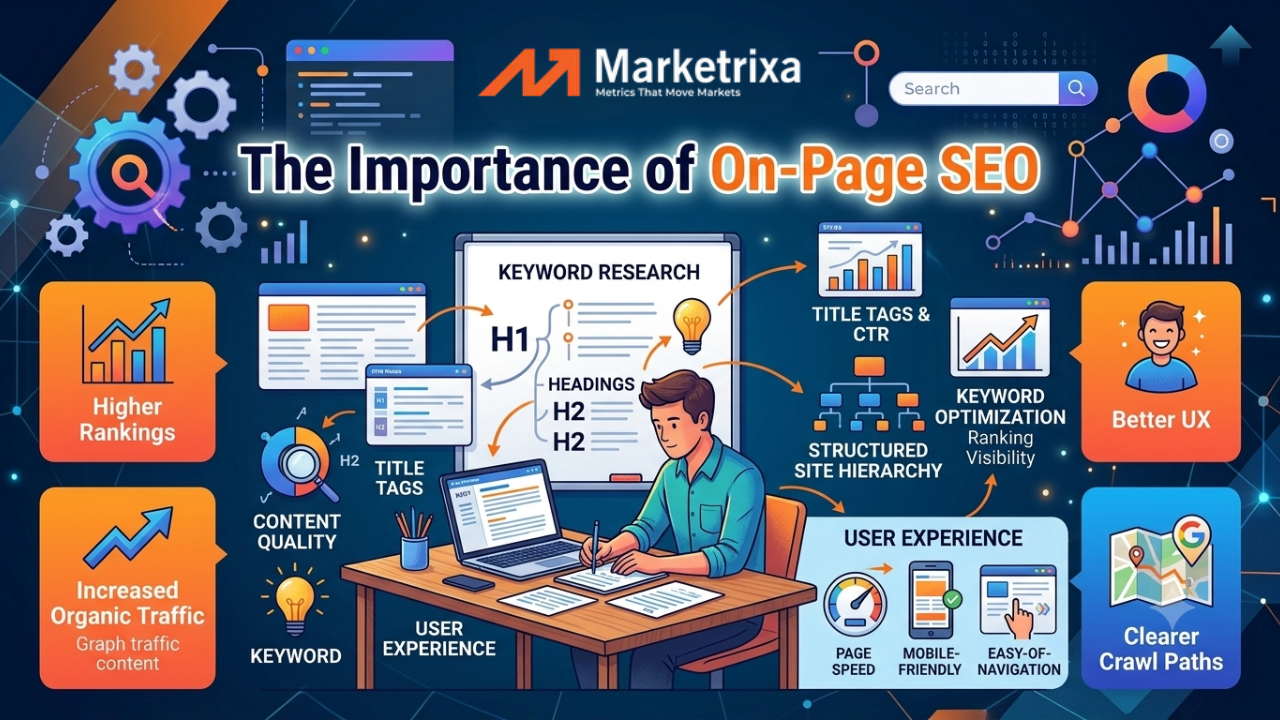
It's worth pausing on the importance of on page SEO specifically, because it's often underestimated compared to technical fixes.
On-page SEO is what helps search engines match your content to the right search intent. It's also what keeps users engaged once they land on your page — reducing bounce rate and increasing dwell time, both of which are strong ranking signals. Good on-page SEO:
Improves click-through rates via compelling titles and meta descriptions
Helps search engines match your page to relevant search queries
Enhances user experience and readability
Supports better internal link equity distribution across your site
Increases the likelihood of ranking for long-tail and semantic keywords
In short, on-page SEO is what turns good content into content that actually performs.
Technical SEO Checklist
If you're unsure where your website stands, here's a practical technical SEO checklist to review:
Site loads in under 3 seconds on both desktop and mobile
Website is fully mobile-responsive
XML sitemap is submitted to Google Search Console
Robots.txt file isn't blocking important pages
HTTPS is enabled sitewide
Canonical tags are correctly implemented to avoid duplicate content
No broken internal or external links
Structured data/schema markup is implemented where relevant
Core Web Vitals (LCP, FID/INP, CLS) meet Google's benchmarks
Site architecture allows easy crawling (no orphan pages)
404 errors and redirect chains are minimized
Images are compressed and properly optimized
Running through this checklist regularly can uncover issues that are quietly capping your rankings, even if your content strategy is otherwise strong.
A Minor Note: The Broader Effect of SEO
Beyond rankings, it's worth remembering that SEO's effect extends well past search visibility alone. A well-optimized website also improves overall user trust, brand credibility, and conversion rates. Faster, cleaner, well-structured sites tend to see lower bounce rates, higher engagement, and better performance across paid campaigns too, since a technically sound website supports every other digital marketing effort, not just organic search. To stay ahead, it also helps to keep an eye on the latest digital marketing trends shaping how businesses approach visibility and growth.
Bringing Technical and On-Page SEO Together
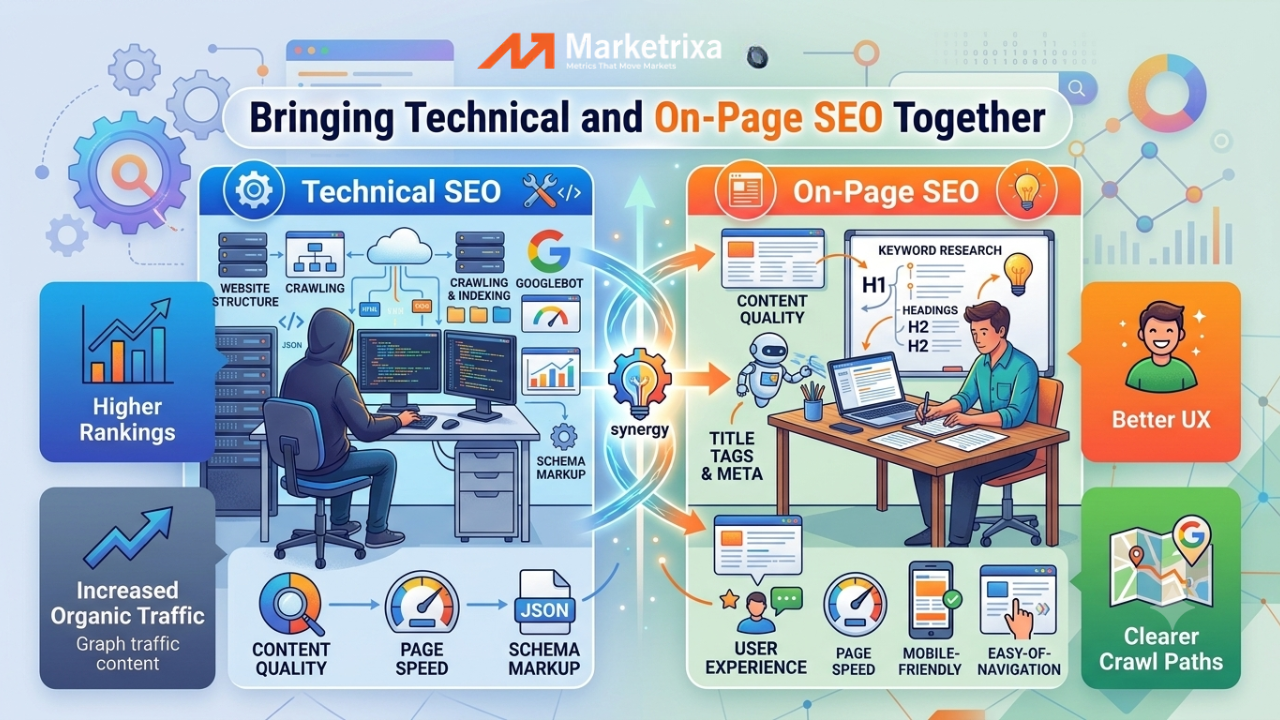
The truth is, technical SEO vs on-page SEO isn't really a competition — it's a partnership. Neither works effectively without the other. Your content strategy needs a technically sound foundation to be discovered, and your technical infrastructure needs strong on-page optimization to actually convert that visibility into rankings and traffic.
At Marketrixa, our approach starts with a full technical audit followed by on-page optimization tailored to your industry and audience. Whether you need a deep technical cleanup, professional on-page SEO services, or a combined strategy, our Ahmedabad-based team builds SEO foundations designed for long-term, sustainable ranking growth — not quick fixes that fade after the next algorithm update. If you're looking at the bigger picture, our guide on digital marketing strategy for business growth shows how SEO fits into a complete growth plan.
If your website has great content but still isn't ranking, the issue likely isn't your writing. It's the technical and on-page framework around it. Get in touch with Marketrixa today for a comprehensive SEO audit and find out exactly what's holding your website back.
Technical SEO vs On-Page SEO: Why You're Not Ranking — FAQs
Tags