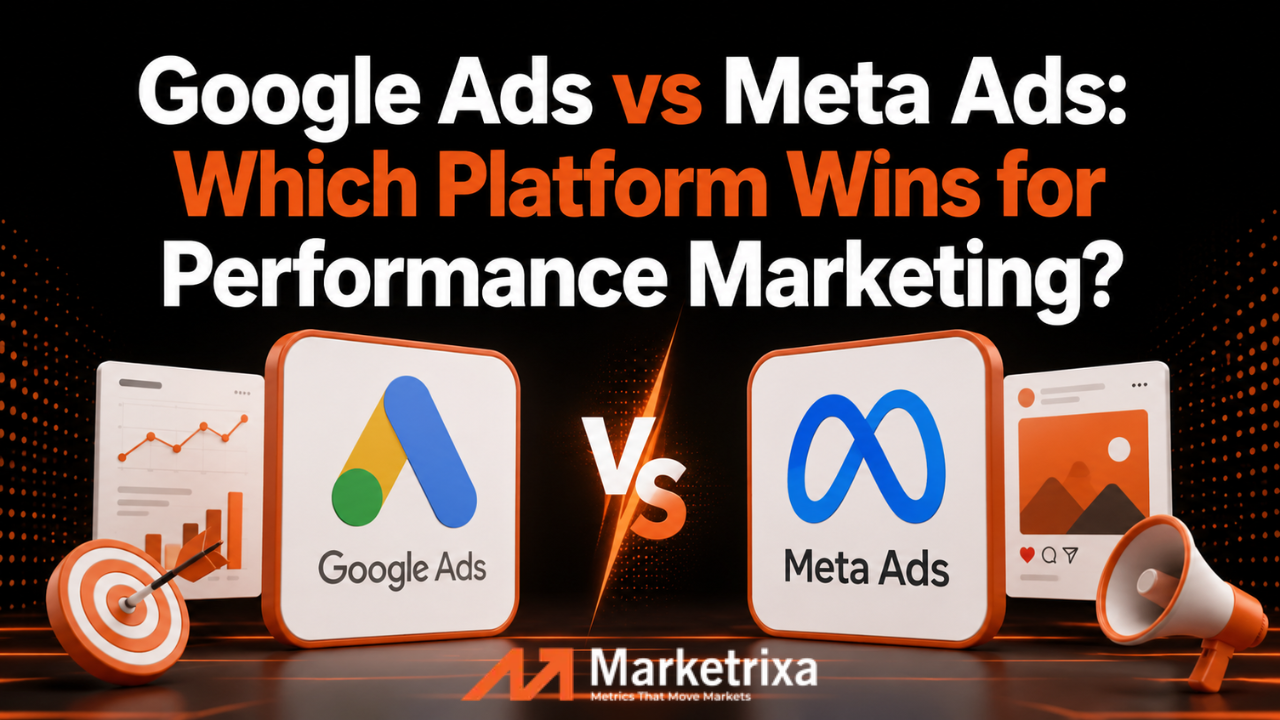
If you're running a business and trying to decide where to put your next advertising rupee, you've probably landed on the same question every marketer eventually asks: Google Ads vs Meta Ads — which one actually delivers better performance?
At Marketrixa, we manage paid campaigns for brands across industries in Ahmedabad and beyond, and this is one of the most common questions clients bring to us. The honest answer? It's not about which platform is "better" in isolation — it's about which platform is better for your specific goal, funnel stage, and product. In this blog, we'll break down both platforms in detail, compare them across the metrics that actually matter for performance marketing, and help you figure out where your budget will work hardest.
Understanding the Core Difference: Intent vs Interest
Before comparing numbers and formats, it's important to understand the fundamental philosophy behind each platform.
Google Ads is an intent-based platform. When someone searches "best CRM software for small business" or "digital marketing agency in Ahmedabad," they are actively looking for a solution. Google Ads puts your brand in front of people at the exact moment they're searching — which is why it's often called "demand capture."
Meta Ads (Facebook and Instagram) is an interest-based platform. Nobody logs into Instagram looking to buy a skincare product, but if your ad shows up in their feed with the right creative, targeting, and offer, you can create that desire. Meta Ads work on "demand generation" — you're interrupting a scroll to introduce a need the person didn't know they had.
This one distinction shapes almost every other difference between the two platforms.
Google Ads: Strengths and Limitations
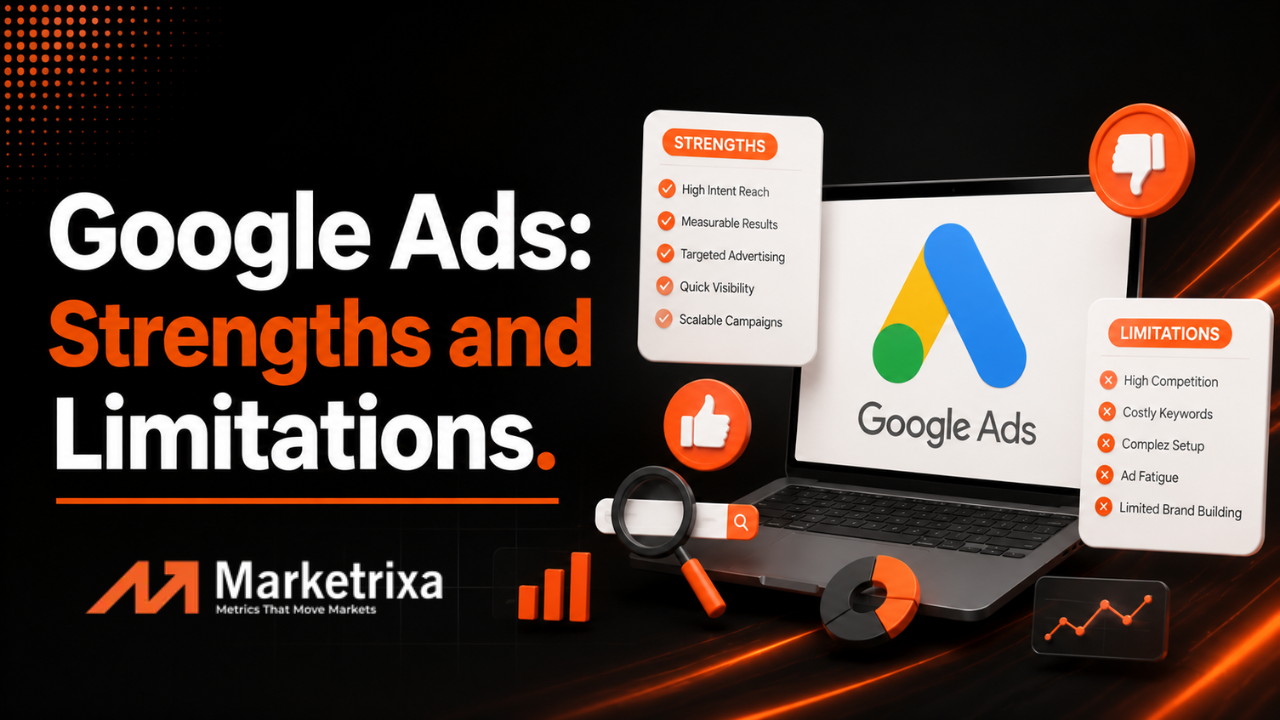
Strengths
High purchase intent — you're targeting people who are already searching for your product/service category.
Strong for lead generation and local businesses — Search and Local campaigns are excellent for service-based businesses that rely on local footfall or inquiries.
Multiple ad formats — Search, Display, Shopping, YouTube, and Performance Max give you reach across the entire Google ecosystem.
Better for high-ticket, considered purchases — insurance, real estate, B2B SaaS, and legal services often perform better here because the buyer is already in research mode.
Limitations
Higher CPCs in competitive industries — keywords like "insurance," "loans," or "digital marketing" can be expensive.
Limited creative storytelling — Search ads are largely text-based; there's less room for brand building and emotional connection.
Depends heavily on keyword research and search volume — if your product is new or category-defining, there may not be existing search demand to capture.
Meta Ads: Strengths and Limitations
Strengths
Powerful targeting and retargeting — including interest, behavior, lookalike, and custom audiences — enable hyper-specific targeting.
Visually rich formats — Reels, Stories, Carousels, and video ads let you tell a brand story, not just sell a product.
Lower entry cost — CPMs are generally more affordable than Google Search CPCs, making Meta great for top-of-funnel awareness at scale.
Excellent for impulse and lifestyle products — fashion, D2C brands, food, fitness, and beauty products often see strong ROAS here because the format supports emotional, visual selling.
Limitations
Lower intent — you're targeting people scrolling for entertainment, not actively shopping.
iOS privacy changes (App Tracking Transparency) have impacted tracking accuracy, making attribution slightly harder than it used to be.
Ad fatigue sets in faster — the same audience seeing the same creative repeatedly leads to declining performance, requiring frequent creative refreshes.
Google Ads vs Meta Ads: A Side-by-Side Comparison
When you look at the two platforms side by side, the differences become clear. Google Ads is built around search intent and keywords, while Meta Ads relies on interests, behavior, and demographics to find the right audience. Google typically plays in the middle-to-bottom of the funnel, capturing people who are closer to a decision, whereas Meta operates more at the top-to-middle, sparking interest before a decision has even been made. This makes Google Ads a strong fit for lead generation, local services, and B2B businesses, while Meta Ads tends to shine for D2C brands, e-commerce, and brand awareness campaigns. In terms of creative flexibility, Google offers moderate options, but Meta gives you far more room to experiment with video, Reels, and carousels. Cost structures differ too — Google usually runs on a CPC model that tends to be higher, while Meta's CPM-based pricing is often more affordable. If you're looking for speed, Google Ads generally delivers faster results in search-heavy niches, while Meta requires more patience and creative testing to hit its stride. And when it comes to scalability, Google is limited by existing search volume, whereas Meta can scale significantly further as long as the creative keeps performing.
The truth is, this isn't really a battle — it's a partnership. Many of the highest-performing accounts we manage at Marketrixa use Google Ads to capture people who are ready to buy, and Meta Ads to build the awareness and desire that eventually sends people to search on Google in the first place.
The Effect of UGC Video in Ads
One trend we can't skip while talking about performance marketing in 2026 is the growing impact of User-Generated Content (UGC) videos — and this is especially relevant to Meta Ads performance.
UGC-style videos — where real people (not polished models or actors) talk about a product in an authentic, phone-shot format — have consistently outperformed traditional, highly-produced ads on Meta platforms. Here's why the effect of UGC video in ads has become such a big deal for performance marketers:
Higher trust and relatability — audiences are fatigued by overly polished ads. UGC feels like a recommendation from a friend rather than a sales pitch, which builds credibility faster.
Better scroll-stopping power — because UGC blends naturally into the Reels/Stories feed format, it doesn't feel like an interruption, which improves watch time and click-through rates.
Lower production cost, faster testing — brands can produce dozens of UGC variations quickly and cheaply, allowing for faster creative testing and optimization cycles.
Stronger performance in the consideration and conversion stage — when paired with retargeting campaigns, UGC videos showing real usage, unboxing, or testimonials significantly improve conversion rates compared to static image ads.
Works well across both platforms — while UGC is most associated with Meta, it's increasingly being repurposed for YouTube in-stream ads and Google Display/Demand Gen campaigns too, extending its impact beyond one platform.
For D2C and e-commerce brands especially, incorporating UGC video into the ad mix is no longer optional — it's often the single biggest lever for improving ROAS without increasing ad spend.
A Minor but Important Note: The Role of SEO
While this blog is focused on Google Ads vs Meta Ads, no performance marketing conversation is complete without mentioning SEO (Search Engine Optimization) — because paid and organic strategies don't compete, they compound.
Here's the effect of SEO on your overall performance marketing results:
Reduces long-term cost per acquisition — as your organic rankings improve, you rely less on paid clicks for the same keywords, lowering your blended CAC over time.
Improves Quality Score on Google Ads — a well-optimized website with strong content and site structure often leads to better Quality Scores, which directly lowers your CPCs.
Builds credibility — users who discover your brand through both an ad and an organic search result tend to trust it more, improving conversion rates.
Supports the entire funnel — while Google and Meta Ads target people right now, SEO continues to bring in traffic 24/7 without ongoing spend, making it the most sustainable channel in your marketing mix.
In short: paid ads get you visibility today, SEO gets you visibility every day after that. A strong performance marketing strategy treats SEO as the foundation, not an afterthought.
In short: paid ads get you visibility today, SEO gets you visibility every day after that. A strong performance marketing strategy treats SEO as the foundation, not an afterthought — and staying up to date with the latest digital marketing trends can help you spot where organic and paid strategies should intersect next.
So, Which Platform Wins?
If we had to give a straight answer: there is no single winner — it depends on your business model.
Choose Google Ads if: you sell a product/service people actively search for, you're in lead generation, local services, or B2B, and you want faster, intent-driven conversions.
Choose Meta Ads if: you're in e-commerce or D2C, your product benefits from visual storytelling, and you want to build brand awareness alongside conversions.
Choose both (which most successful brands do) if: you want a full-funnel strategy — Meta to generate demand and awareness, Google to capture that demand when it turns into an active search.
Final Thoughts
The Google Ads vs Meta Ads debate isn't really about picking a side — it's about understanding your customer's journey and meeting them at the right moment with the right message. Combine that with authentic, high-converting UGC video creatives and a solid SEO foundation, and you have the ingredients for a genuinely full-funnel performance marketing strategy.
At Marketrixa, we help brands in Ahmedabad and across India build data-backed campaigns on Google, Meta, and organic search — so you're not just spending on ads; you're investing in compounding growth.
Want a platform strategy tailored to your business? Get in touch with Marketrixa for a free performance marketing audit.
Google Ads vs Meta Ads: Which one Wins for Performance Marketing — FAQs
Tags