If you've ever sat in a budget meeting arguing over whether to spend on a billboard or a Google Ads campaign, you already know this debate isn't going away. In 2026, the question isn't just theoretical anymore. Businesses across Ahmedabad and across India are being forced to justify every rupee of their marketing budget with actual numbers.
That's where performance marketing enters the conversation. Unlike traditional advertising, which relies on reach and hope, performance marketing ties every spend to a measurable outcome — a click, a lead, a sale.
This blog breaks down both approaches honestly. No bias, no fluff. Just a practical look at what works, what doesn't, and which one is likely to deliver better ROI for your business this year.
Which is better: performance marketing or traditional marketing?
Performance marketing is generally better for measurable ROI, precise audience targeting, and budget control, since it tracks every click, lead, and sale in real time. Traditional marketing still supports broad brand awareness, but performance marketing typically delivers faster, more trackable, and more cost-efficient results in 2026.
What is Performance Marketing?
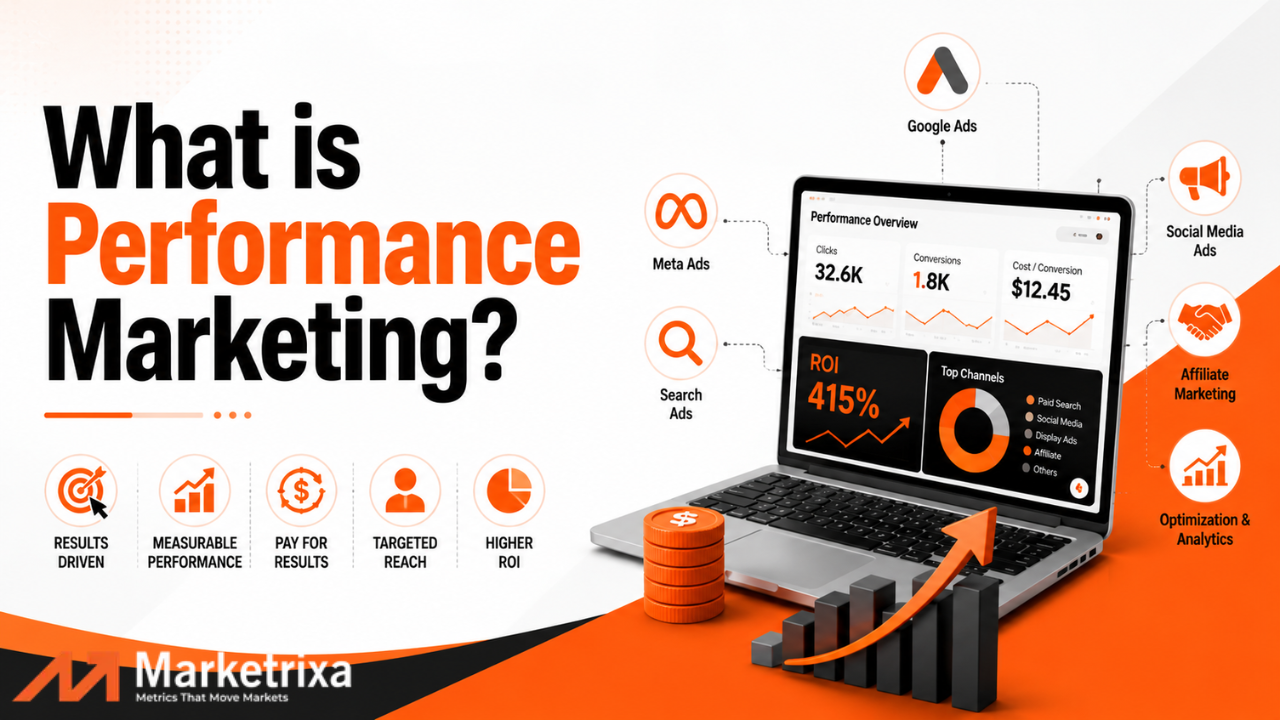
Performance marketing is a form of digital advertising where businesses pay only when a specific action happens. That action could be a click, a lead form submission, an app install, or an actual sale.
It runs on platforms like Google Ads, Meta Ads, Facebook Ads, LinkedIn, and programmatic ad networks. Every campaign is tracked, measured, and optimized in real time.
Here's a simple example. A skincare brand in Ahmedabad runs a Meta Ads campaign targeting women aged 25–40 interested in organic beauty products. They only pay when someone clicks the ad or completes a purchase. If the campaign underperforms, it gets adjusted within hours, not months.
That's the core idea behind performance marketing — accountability. There's no guessing whether the marketing budget was well spent, because the data tells you immediately.
What is Traditional Marketing?
Traditional marketing includes offline channels like TV commercials, radio spots, newspaper ads, hoardings, brochures, and direct mail.
It's built around mass reach rather than precise targeting. A newspaper ad in Ahmedabad might reach thousands of readers, but there's no way to know exactly who saw it, engaged with it, or acted on it.
Traditional marketing still has a place, especially for building long-term brand recall. A well-placed billboard on SG Highway can create strong local visibility. But measuring its direct contribution to sales is difficult, if not impossible.
This lack of precise tracking is the single biggest gap between traditional marketing and performance marketing.
Key Differences Between Performance Marketing and Traditional Marketing
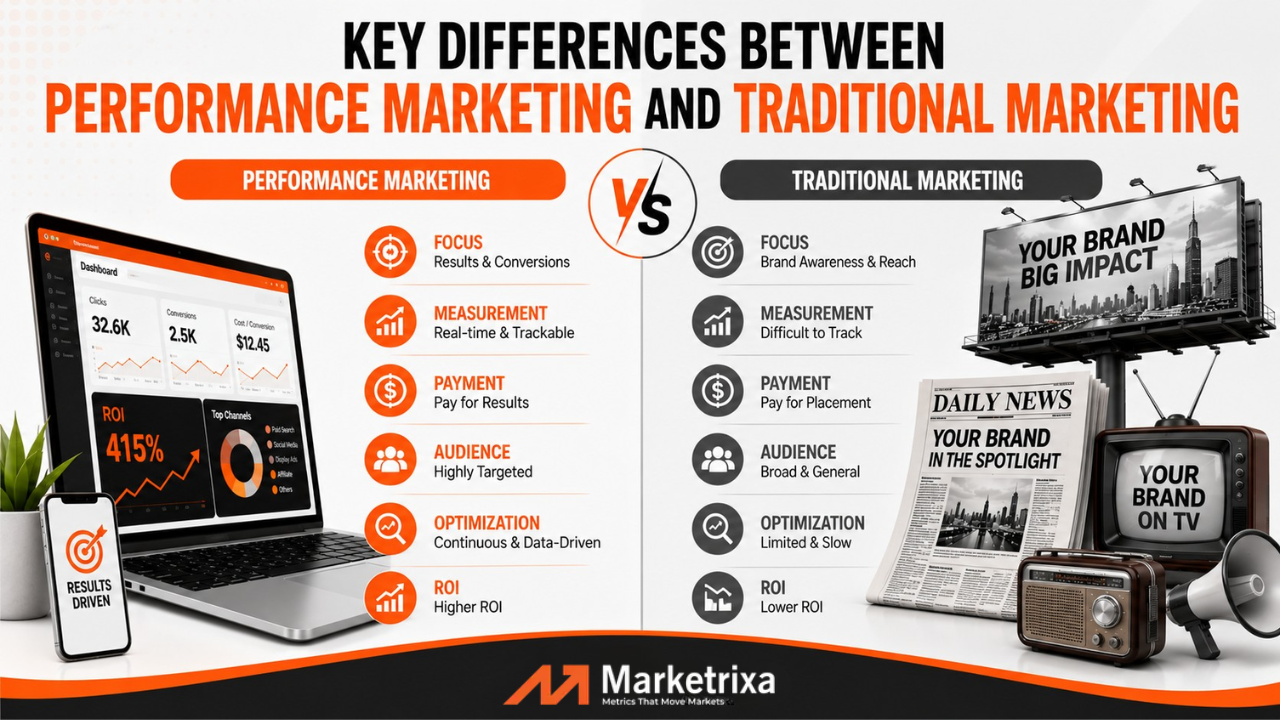
The differences go far beyond just "online vs offline." They affect cost, control, speed, and ultimately, ROI.
Factor Performance Marketing Traditional Marketing
Cost Pay-per-result, flexible budgets Highly upfront cost
ROI Measurable and trackable Difficult to calculate
accurately
Tracking Real-time, detailed analytics Little to no direct tracking
Audience Targeting Highly specific Broad, generalized audience
Flexibility: Campaigns adjusted instantly. Fixed once published or aired
Speed Results visible within days. Results take weeks or months to assess
Scalability: Easy to scale up or down. Scaling requires significant new investment
Lead Generation: Direct and trackable lead capture Indirect, relies on brand recall
Budget Control: Full control, daily/monthly caps. Limited control once committed
Analytics Deep marketing analytics Minimal or
and reporting estimated data
Why Performance Marketing is Growing Faster in 2026
A few things have changed the game this year.
First, ad platforms have gotten smarter. AI-driven bidding on Google Ads and Meta Ads now optimizes campaigns automatically based on conversion data, not just clicks.
Second, customer behavior has shifted almost entirely online. Whether it's a manufacturing company looking for B2B leads or a local restaurant chasing footfall, the buying journey now starts with a search or a scroll.
Third, marketing budgets are under more scrutiny than ever. CFOs want to see cost per acquisition and return on ad spend, not just impressions. Performance marketing gives them exactly that.
And finally, marketing automation tools have made it possible to run, track, and optimize dozens of campaigns simultaneously without a massive in-house team.
ROI Comparison: Performance Marketing vs Traditional Marketing
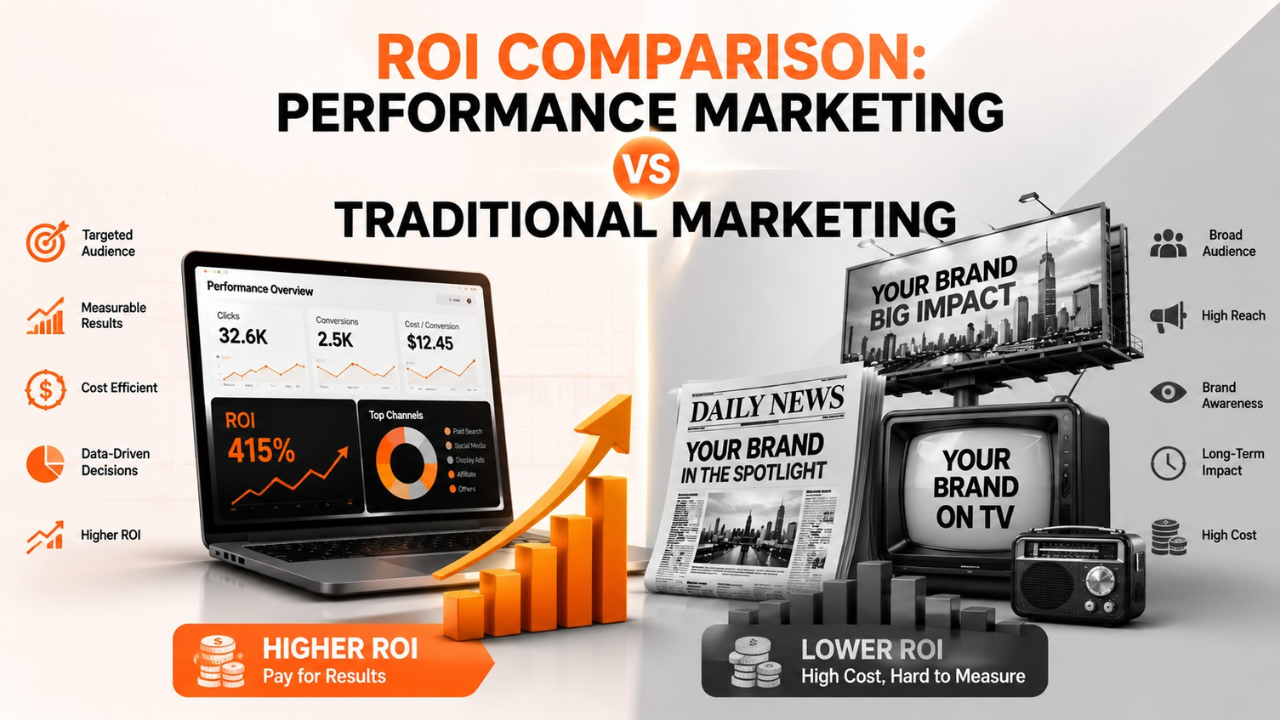
Let's talk numbers, because that's really what this debate comes down to.
With performance marketing, ROI can be tracked down to the last rupee. If a business spends ₹50,000 on a Google Ads campaign and generates ₹2,00,000 in sales, that's a clear 4x return on ad spend. Every metric — cost per acquisition, conversion rate, customer lifetime value — is visible.
With traditional marketing, calculating ROI is largely a guessing game. A company might spend ₹5,00,000 on a print campaign and see a bump in sales the following month, but there's no reliable way to attribute that increase directly to the ad.
This doesn't mean traditional marketing has zero value. Brand awareness matters, especially for larger companies with bigger budgets. But when the goal is measurable marketing results and efficient customer acquisition, performance marketing consistently wins.
Benefits of Performance Marketing
Precise targeting: Reach the exact audience based on demographics, interests, and online behavior.
Real-time optimization: Underperforming ads can be paused or adjusted immediately.
Transparent reporting: Every rupee spent is tied to a specific outcome.
Budget flexibility: Start small, scale up once results prove positive.
Faster lead generation: Campaigns can start driving leads within days of launch.
Better conversion rate optimization: Continuous testing improves results over time.
For a startup with limited funds, this flexibility is often the difference between surviving the first year and shutting down.
Limitations of Traditional Marketing
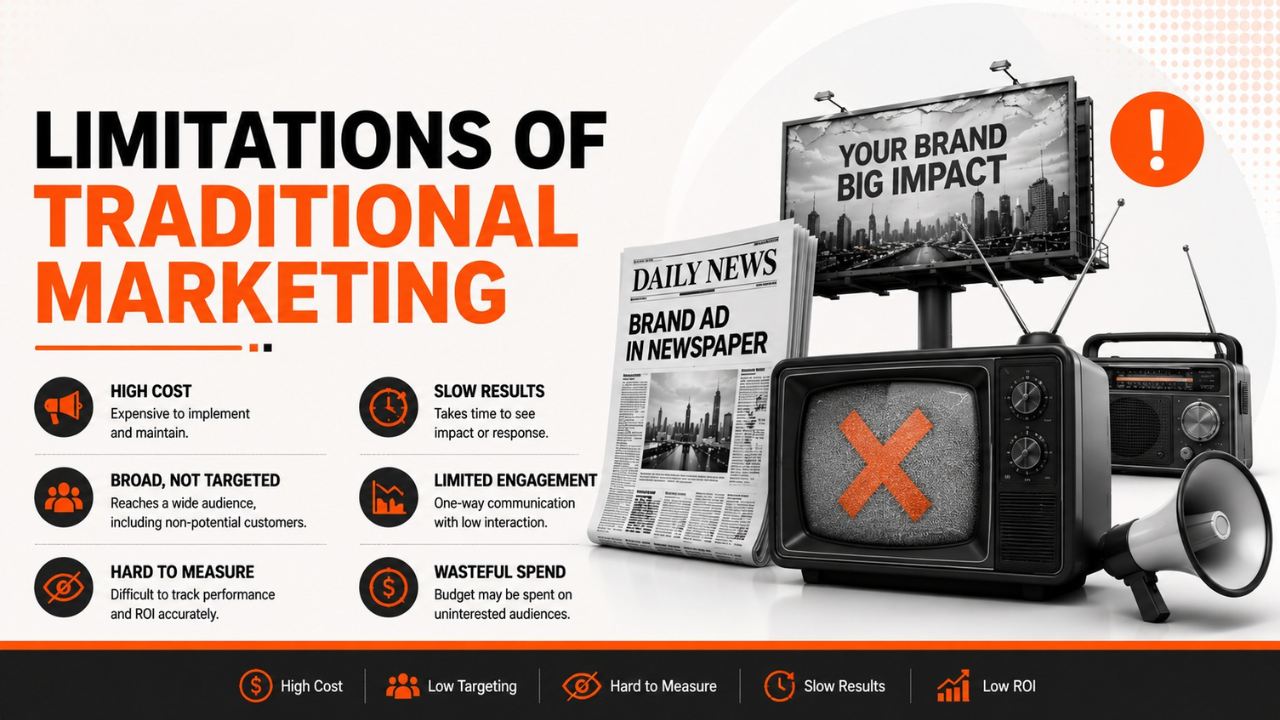
Traditional marketing isn't without merit, but its limitations are becoming harder to ignore.
No real-time tracking: You won't know how a campaign is performing until it's already over.
High fixed costs: A TV or newspaper campaign costs the same whether it converts or not.
Limited targeting: You're reaching a general audience, not a specific buyer persona.
Slow adjustments: Once a hoarding is printed or an ad airs, changes aren't possible mid-campaign.
Difficult to scale efficiently: Doubling reach usually means doubling cost, with no guarantee of proportional results.
For small and medium businesses working with tight marketing budgets, these limitations can make traditional marketing a riskier bet.
When Should Businesses Choose Performance Marketing?
Performance marketing service makes the most sense when:
You need measurable results within a short timeframe
Your budget requires careful tracking and control
You're targeting a specific, well-defined audience
Lead generation or direct sales are the primary goal
You want to test messaging and creatives before committing bigger spend
An e-commerce store launching a new product, for instance, benefits far more from a well-targeted Google Ads and Meta Ads campaign than from a generic print ad.
Industries That Benefit Most from Performance Marketing
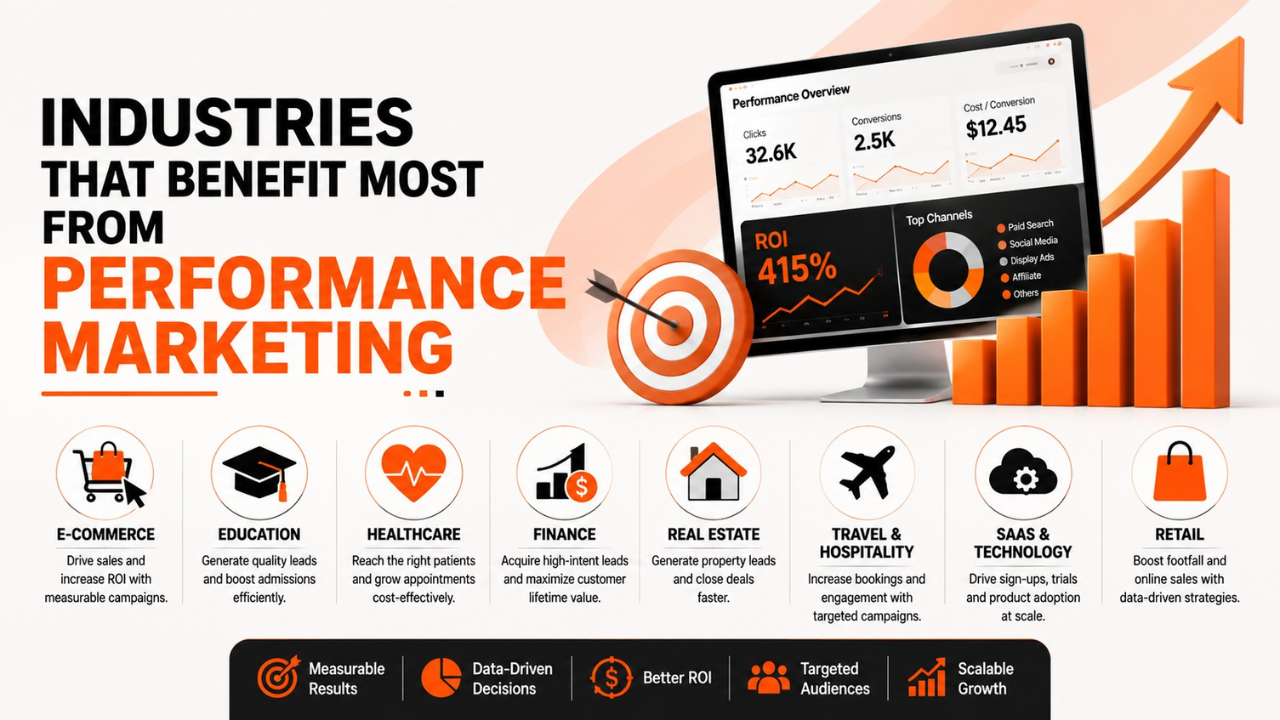
Some industries see faster, clearer results from performance marketing than others:
E-commerce: Direct sales tracking, retargeting, and cart abandonment campaigns drive strong ROAS.
Healthcare: Local search and lead generation campaigns help clinics and hospitals attract patients efficiently.
Manufacturing (B2B): LinkedIn and Google Ads help generate qualified leads with longer sales cycles.
Local businesses: Location-based targeting drives footfall and local brand awareness cost-effectively.
Startups and SMEs: Limited budgets go further with pay-per-result campaigns instead of fixed-cost traditional ads.
If your business falls into any of these categories, shifting more budget toward performance-based channels is worth serious consideration.
Why Hiring a Performance Marketing Agency Makes Sense
Running performance marketing campaigns well isn't as simple as boosting a Facebook post or setting up a Google Ads account.
It requires ongoing management of bidding strategies, audience segmentation, creative testing, landing page optimization, and budget allocation across platforms. Most in-house teams, especially at SMEs, don't have the bandwidth or specialized knowledge to manage this properly.
A dedicated performance marketing agency brings structured processes, platform expertise, and access to marketing analytics tools that most businesses don't have in-house. This isn't about outsourcing for the sake of it — it's about avoiding costly trial-and-error that eats into your marketing budget.
At Marketrixa, this is exactly the gap we work to close for businesses across Ahmedabad and beyond, combining SEO Services, Google Ads Services, and Social Media Marketing under one data-driven strategy.
How a Performance Marketing Expert Helps Improve ROI
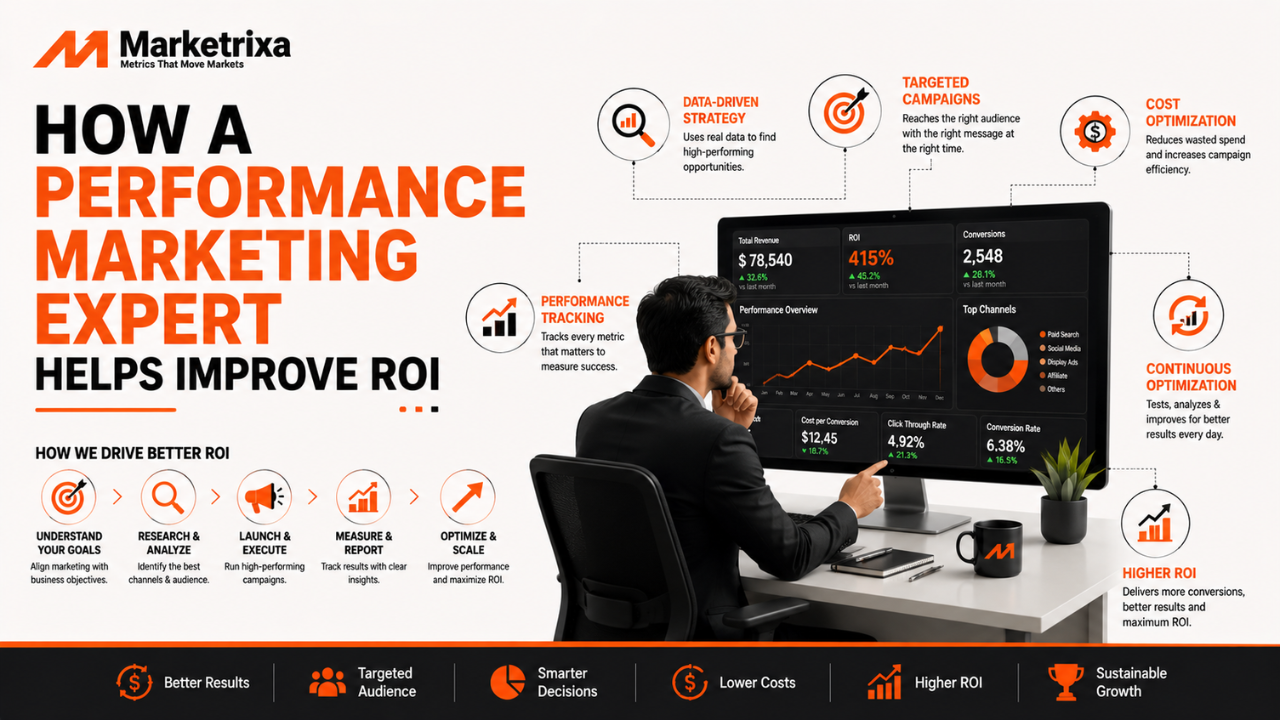
A performance marketing expert does more than just launch ads. Their real value shows up in the details.
They analyze historical campaign data to identify what's actually driving conversions, not just clicks. They test multiple ad creatives and landing pages to see what resonates with your specific audience.
They also fine-tune targeting continuously, cutting wasted spend on audiences that don't convert. And they connect the dots between platforms, ensuring your Google Ads, Meta Ads, and website work together instead of in isolation.
This is often where businesses see the biggest improvement — not from spending more, but from spending smarter.
Common Mistakes Businesses Make
Even with the right intentions, many businesses get performance marketing wrong.
Chasing clicks instead of conversions: A high click-through rate means nothing if it doesn't lead to sales or leads.
Ignoring landing page quality: Great ads sending traffic to a slow, confusing website waste budget.
Setting and forgetting campaigns: Performance marketing requires ongoing optimization, not a one-time setup.
Underestimating the value of website development: Poor site speed or design directly hurts conversion rates.
Not tracking the right metrics: Focusing on vanity metrics instead of cost per acquisition and ROAS.
Avoiding these mistakes alone can significantly improve campaign performance.
Future Trends in Performance Marketing (2026)
A few trends are shaping performance marketing this year and beyond.
AI-powered campaign optimization is becoming standard, with platforms automatically adjusting bids and targeting based on real-time conversion data. Marketing automation is reducing manual workload while improving consistency across campaigns.
Privacy changes across platforms are also pushing businesses toward first-party data collection, making strong website development and CRM integration more important than ever.
Video-first ad formats continue to dominate engagement, particularly on Meta and YouTube. And cross-channel attribution tools are getting better at showing exactly how different touchpoints contribute to a final conversion.
Businesses that adapt to these shifts early will have a clear advantage over competitors still relying on outdated tactics.
Conclusion
Traditional marketing still has a role, particularly for large-scale brand building. But when it comes to measurable ROI, precise targeting, and efficient use of marketing budget, performance marketing is the clear winner in 2026.
The ability to track every rupee, optimize campaigns in real time, and scale based on actual data makes it a far more accountable approach for most businesses today.
That said, running performance marketing effectively takes expertise, consistent testing, and the right strategic partner.
Ready to Maximize Your Marketing ROI?
If you're tired of guessing whether your marketing budget is actually working, it's time for a different approach. Marketrixa helps businesses across Ahmedabad build data-driven performance marketing strategies — from Google Ads and Meta Ads to full-scale Digital Marketing Services — designed around measurable results, not vanity metrics.
Get in touch with Marketrixa today for a free consultation and see what a results-focused strategy can do for your ROI.